Severe Erosion Repair, Now Robotic
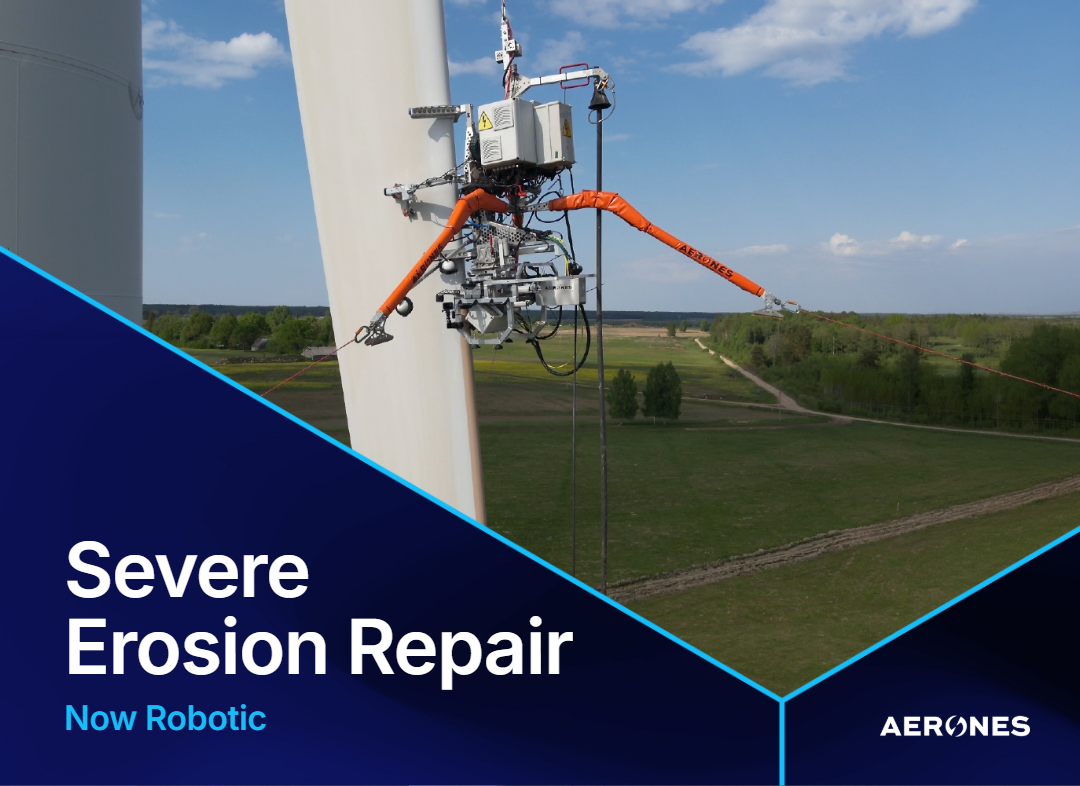
Aerones has completed its first robotic repairs of severe leading edge erosion on wind turbine blades.
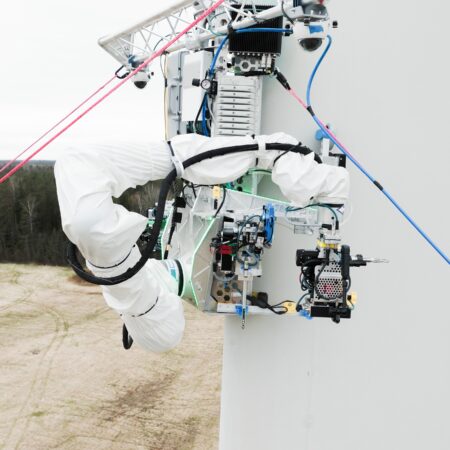
The robotic system removes the damaged material to a sound laminate and restores and rebuilds the leading edge in UV-cured layers. The entire process is remotely operated from the ground, eliminating rope access and providing full digital QA/QC traceability. Severe erosion repairs now run at one blade per day.
Key facts
What: robotic repair of severe leading edge erosion, where the laminate is exposed
Speed: about 10 m of leading edge per day, against 1–5 m for rope access teams
Downtime per Blade: about 12 hours per blade, fully robotic
Durability: on the same blade, the robotic repair still held its profile after 2.5 years, while the manual repair had eroded again
Adhesion: 15 MPa pull-off strength achieved on polyester substrates; tests indicate cohesive failure within the original base laminate rather than at the repair interface
Depth restored: Successful recovery of 3–4 mm deep erosion cavities, utilizing successive, UV-polymerized fibre-reinforced layers to rebuild the designed geometry.
Post-Repair QA/QC & Monitoring
Scale: 1,500 blades repaired with robotic leading edge repair in 2026, up from 300 in 2024
What is severe leading edge erosion?
Leading-edge erosion is defined as advanced material degradation that has breached the Leading-Edge Protection (LEP) system, penetrating into the base load-carrying composite laminate. Because the structural substrate is compromised, the required intervention shifts from superficial maintenance to a full structural composite restoration. Without immediate remediation, this level of erosion disrupts the designed aerodynamic geometry, causes substantial aerodynamic losses, and jeopardizes the long-term structural integrity of the rotor blade. This degradation mechanism remains a dominant operational risk across aging wind fleets.
Why does severe erosion need to be repaired fast?
Severe erosion costs energy every day it is left. Independent research puts the annual energy production (AEP) loss at 1.8–2% for moderate erosion and up to about 5% for severe erosion (Sandia National Laboratories). Data from operating turbines shows losses of 3–8% (Panthi et al., Wind Energy, 2023), and a modelled severe case on the outer third of the blade lost 4.3% (DTU/CENER, 2024).
Repair costs grow just as fast. On one US wind park, untreated erosion progressed like this per turbine:
Year | Erosion per blade | Energy lost per year | Estimated repair cost |
1 | 0 m | 0 MWh | $0 |
2 | 1.3 m | ~65 MWh | $5,400 |
3 | 4.9 m | ~142 MWh | $10,800 |
4 | 7.3 m, severe | ~258 MWh | $16,200 |
5 | 9.1 m, severe | ~390 MWh | $32,400 |
Costs are per turbine and assume $120 per technician hour. The earlier severe erosion is repaired, the less it costs.
What are the options for repairing severe erosion?
Until now, OEMs, owners/operators and ISPs had two choices. Automated robotic restoration introduces a third, optimized alternative.
Option | What it involves |
Full Blade Replacement | Highest cost, long lead times for new blades, cranes and extended turbine downtime |
Manual Rope-Access Repair | Rope access technicians manually prepare the surface and execute hand lay-up lamination at height. Slow, weather-bound, time-intensive, and yields variable aerodynamic profiles depending on individual technician proficiency. |
Automated Robotic Restoration | Operated entirely from the ground, the robotic system restores the designed aerodynamic profile with standardized repeatability across every asset. |
How does Aerones repair severe erosion with robots?
The entire process is remotely operated from the ground, eliminating rope access. Every operational sequence is digitally recorded to ensure full QA/QC traceability. The system achieves full UV-polymerization for each layer before proceeding, resolving both localized structural damage and extended longitudinal cracks without the need for manual patching or vacuum consumables.
Surface Preparation. Robotic grinding removes the eroded material.
Primer. A UV primer is applied by spatula for maximum adhesion.
Structural Restoration. A fibre-reinforced, UV-curable compound is extruded and profiled layer-by-layer to incrementally rebuild the structural geometry
Controlled Curing. High-intensity UV arrays achieve full polymer cross-linking in minutes. This environmentally decoupled curing process permits reliable operation at temperatures as low as +5 °C.
Leading-Edge Protection. A standardized LEP system – filler, BladeRep® Topcoat 12, and Hontek sprayable LEP – is applied to encapsulate and protect the restored laminate.
Automated application guarantees strict conformity to the designed aerodynamic profile across every asset, mitigating the uneven thicknesses and stress concentrations that typically compromise manual repairs. As confirmed by independent Catapult testing, standardized application methodology on-site is a more critical determinant of LEP durability than baseline material properties alone.
Does a robotic repair last longer than a manual one?
On one blade, the upper section was repaired by the Aerones robot and the lower section by rope access technicians. After two and a half years in operation, the robotic section is still even, with no serious erosion. On the manually repaired section, serious erosion has returned.
How strong is a robotic severe erosion repair?
The Aerones Laboratory tested the repair on an original LM 62.2 blade before taking it to the field.
15 MPa adhesion on polyester. In pull-off tests, the blade substrate failed before the repair bond.
3–4 mm of erosion depth restored. Each UV-cured layer was measured in microscope cross-sections.
How does robotic repair compare with rope access?
For a 10-metre leading edge lamination, robots finish faster and cost less, mainly because the turbine stands still for less time.
Rope access technicians | Aerones robots | |
Repair speed | 1–5 m per day | 10 m+ per day |
Cost per metre, with material | $1,400–1,600 | $800–1,000 |
Repair cost, 10 m | $14,000–16,000 | $8,000–10,000 |
Downtime cost | $2,000–5,000 | $1,500–2,500 |
Total, repair and downtime | $16,000–21,000 | $9,500–12,500 |
On US wind park blades where erosion became severe within a year, rope access lamination followed by robotic protection was estimated at 37–45 hours per blade. The fully robotic repair takes about 12.
How is the quality of each repair checked?
No repair stage is signed off until the Aerones quality control team has checked it live. Robot cameras stream every stage over three Starlink links per crew. QC reviews the footage in Visual Inspection Studio while the crew is still at the blade.
Mandatory inspection gates are established after surface preparation, filler application, intermediate profiling, topcoat application, and final Leading-Edge Protection application. Any deviation goes straight to the robotic team lead and is fixed on the spot. QC runs seven days a week, covering European, Australian and US projects.
How is a repair followed up?
Every repair is handed over with photo documentation of each step. Drone inspections then check the result:
1 week: early adhesion and surface check
1 month: performance under operating loads
6 months: durability across seasons
12 months: long-term durability
All inspection data is shared and reviewed with the operator. Drone checks need no rope teams and minimal turbine downtime.
Frequently asked questions
Can severe leading edge erosion be repaired by robots? Yes. Aerones completed its first robotic severe erosion repairs in 2026. The robot removes the damage, structurally rebuilds the composite laminate using UV-cured layers and applies final leading-edge protection entirely from the ground
How long does a robotic severe erosion repair take? About 12 hours per blade, or roughly one blade per day.
Do technicians need to work at height? No. The crew rigs the robot and operates it from the ground. There is no rope access during the repair.
Does the repair work in cold weather? Yes. The targeted UV-curing technology polymerizes the material in minutes, allowing reliable application and full curing at temperatures as low as +5 °C.
How long does a robotic repair last? On a blade repaired both ways, the robotic section was still even after 2.5 years in operation, while the manual section had eroded again. Every repair is followed by drone inspections over 12 months to confirm its durability.
Which part of the blade can the robot repair? The leading edge along the main section of the blade. The tip area is not covered yet.
Is robotic repair an alternative to replacing the blade? For severe erosion, yes. Replacing a blade means high costs, long lead times, cranes and extended downtime. Robotic repair rebuilds the original leading edge on the turbine, from the ground.
About Aerones
Aerones is the world’s leading robot-enabled wind turbine maintenance and inspection service provider. Its patented robotics let service teams deliver faster, safer and more effective inspections, cleaning, coating and repairs for wind operators worldwide. Aerones has serviced more than 20,000 turbines in over 35 countries.
Get your severely eroded blades fixed. Contact the Aerones sales team at [email protected] to plan robotic severe erosion repairs for your fleet.